Conjunction (used in writing and formal speech only) (Intermediate ㊥ 18)
A conjunction that expresses something that is contrasted with what is expressed in the previous sentence.
Equivalent: But; however; yet; nevertheless
| S1 informal | だが、S2 informal | |
| あの人の話は面白い。だが、内容がない。 | His talk is interesting, but there is no content |
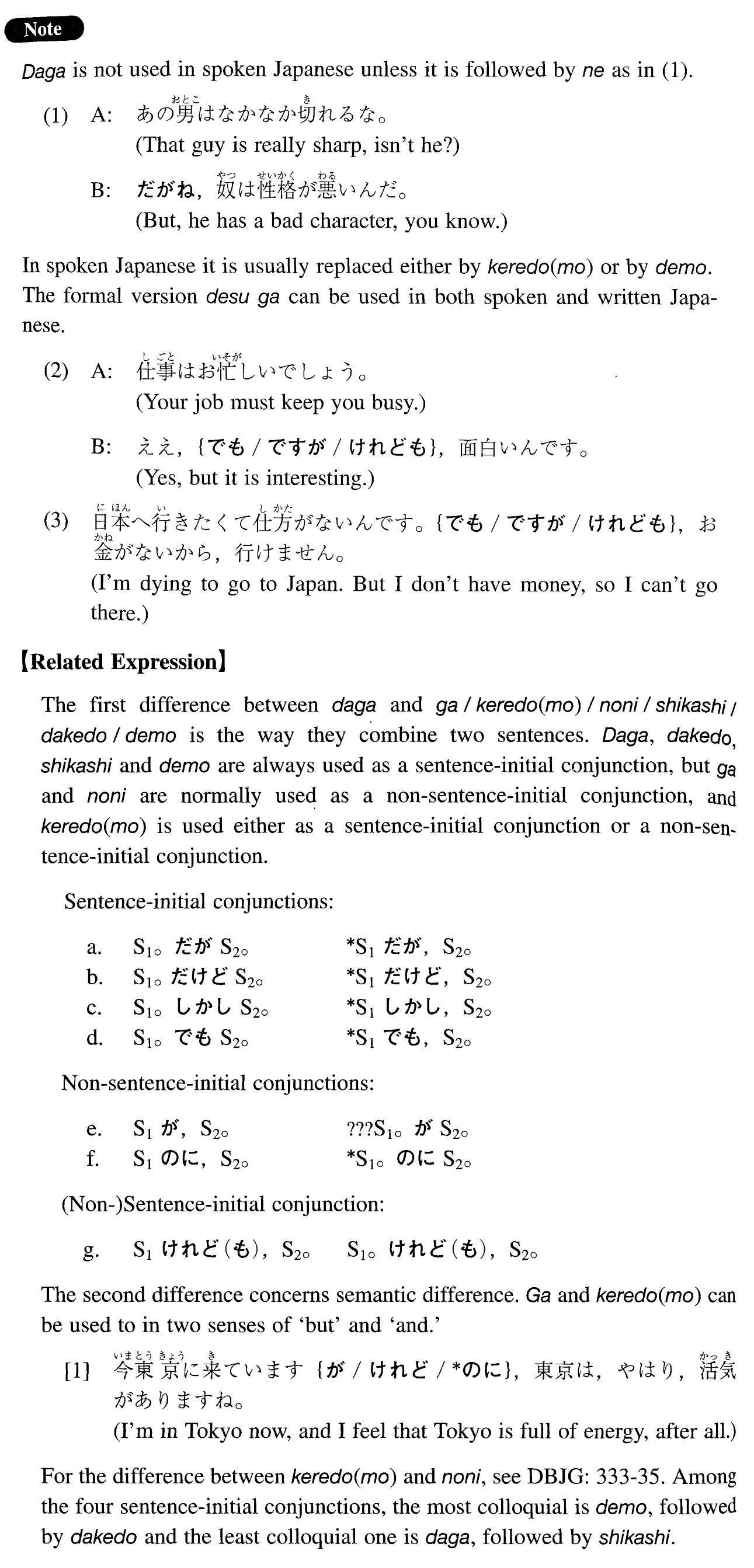
だが is not used in spoken Japanese unless it is followed by ね as in (1).
In spoken Japanese it is usually replaced either by けれど(も) or by でも. The formal version ですが can be used in both spoken and written Japanese.
【Related Expression】
The first difference between だが and が/けれど(も) /のに/しかし/だけど/でも is the way they combine two sentences. だが, だけど, しかし and でも are always used as a sentence-initial conjunction, but が and のに are normally used as a non-sentence-initial conjunction, and けれど(も) is used either as a sentence-initial conjunction or a non-sentence-initial conjunction.
Sentence-initial conjunctions:
| a. | Sentence1。だがSentence2。 | *Sentence1だがだが、Sentence2。 |
| b. | Sentence1。だけどSentence2。 | *Sentence1だけど、Sentence2。 |
| c. | Sentence1。しかしSentence2。 | *Sentence1しかし、Sentence2。 |
| d. | Sentence1。でもSentence2。 | *Sentence1でも、Sentence2。 |
Non-sentence-initial conjunctions:
| e. | Sentence1が、Sentence2。 | ???Sentence1。がSentence2。 |
| f. | Sentence1のに、Sentence2。 | *Sentence1。のにSentence2。 |
(Non-)Sentence-initial conjunction:
| g. | Sentence1けれど(も)、Sentence2。 | Sentence1。けれど(も)、Sentence2。 |
The second difference concerns semantic difference. が and けれど(も) can be used to in two senses of 'but' and 'and.'
[1]
For the difference between けれど(も) and のに, see のに. (⇨ のに㊦) Among the four sentence-initial conjunctions, the most colloquial is でも, followed by だけど and the least colloquial one is だが, followed by しかし.